Book of the Month: Reflections on Joyful by Ingrid Fetell Lee
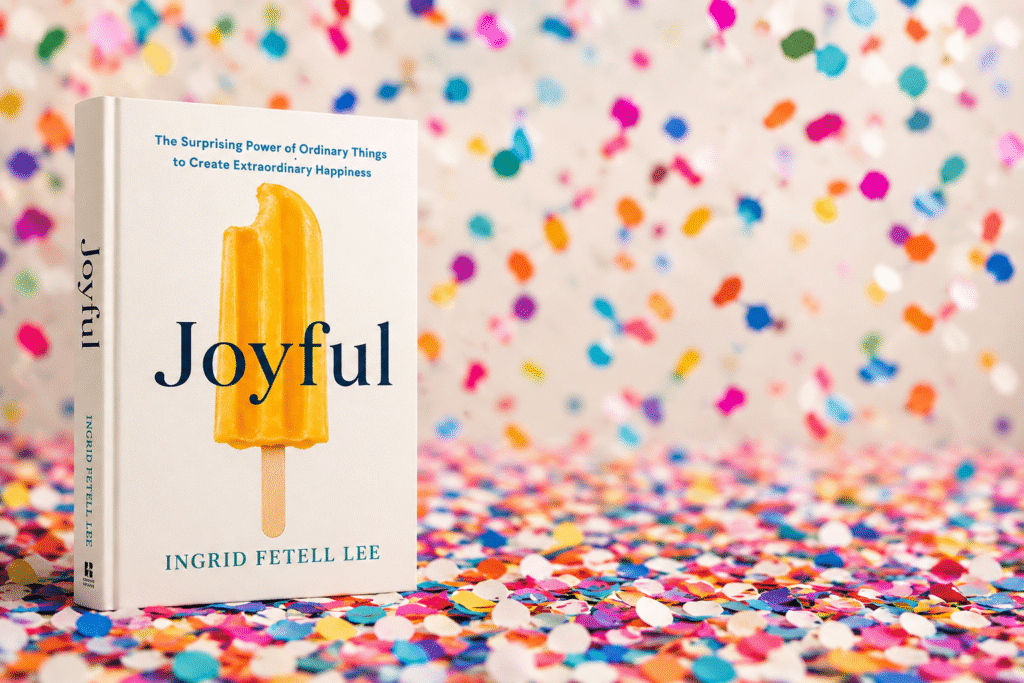
A few years ago, I attended a conference where one of the scheduled lectures was entitled “How Style Will Save the World.” I remember being intrigued by the audacity of the claim and genuinely curious about how its proponent would argue it. Unfortunately, the lecture was cancelled at the last minute, and I never got to hear the answer. However, I think I may have found a version of it in Ingrid Fetell Lee’s profound and nuanced Joyful.
I’ll admit that I initially fell into the trap of thinking about the whole topic of joy somewhat dismissively. When I read the blurb on the front cover — “This book has the power to change everything” –I thought to myself, skeptically, that it seemed hyperbolic; that very reaction now strikes me as symptomatic of how our culture tends to treat joy itself: as something frivolous, decorative, and vaguely unserious. Reading Joyful convinced me of something very different. As Fetell Lee writes, “the drive toward joy is synonymous with the drive toward life.”
In today’s world, we measure almost everything in terms of achievement, productivity, optimization, and endless striving. Joy is often framed as an afterthought — pleasant perhaps, but hardly essential, and more of a luxury or even a distraction from what really matters. Fetell Lee argues the opposite. Through her ten “aesthetics of joy” — Energy, Abundance, Freedom, Harmony, Play, Surprise, Transcendence, Magic, Celebration, and Renewal — and by exploring them in all their declinations and implications, she demonstrates that the visual elements humans consistently experience as joyful are deeply connected to expressions of vitality found throughout nature and to our own course of evolution.
Flowers push outward and upward. Curves and circular forms suggest growth, continuity, softness, and movement. Sparkle mimics water and firelight. Color becomes what she calls “energy made visible.” Even seemingly simple motifs like polka dots or clusters of berries begin to take on deeper meaning. Fetell Lee explains how clustered berries instinctively signal abundance and flourishing: richness, nourishment, sweetness, life at its peak. A bowl overflowing with cherries or strawberries feels joyful not just because it is beautiful, but because, on some primordial level, it communicates vitality.
Polka dots similarly echo bubbles, seeds, confetti, flower clusters, and repeating natural forms that create rhythm, movement, expansion, and delight. Fetell Lee even connects this delight in repetition to Yayoi Kusama’s immersive installations, where dots become almost cosmic, transforming space into something exuberant and transcendent. After reading this book, I do not think I will ever look at a berry or a polka dot in quite the same way again!
That is exactly part of what makes Joyful so compelling. It slowly shifts your perception of ordinary things and makes you examine commonplace things almost the way a child would — and novelty itself is something Fetell Lee identifies as a source of joy. Interestingly, simply contemplating and applying the ideas in the book begins to produce joy in itself!
After reading Joyful, what once seemed merely decorative begins to reveal itself as part of a deeper visual language tied to life itself. As Fetell Lee writes:“Joy evolved for the express purpose of helping to steer us toward conditions that would encourage us to flourish.”
What surprised me most was how convincingly the book connects aesthetics not just to taste, but to psychology, physiology, memory, emotion, social connection, and even hope. At its core, Joyful argues that beauty, surprise, softness, rhythm, ornament, light, movement, and sensory richness are not superficial indulgences. They are forms of psychological nourishment.
In a cultural moment dominated by sterile minimalism, emotional flattening, hyper-productivity, and visual sameness, Joyful feels quietly radical. It serves as a defense of delight, wonder, beauty, emotional vitality, and even enchantment as legitimate human needs. Reading it, I found myself thinking less about decoration and more about emotional atmosphere — about the ways spaces, colors, textures, objects, and rituals subtly shape how we feel and move through the world.
At the beginning of the book, Fetell Lee quotes Diana Vreeland’s famous line: “Without emotion, there is no beauty.” After reading Joyful, I found myself arriving at a kind of inverse conclusion: “Without beauty, there is no joy.”
Ultimately, Joyful is not simply a book about happiness. It is not merely a compilation of what makes for a joyful object or experience –it is a manifesto about what helps human beings feel fully alive.