Why This Book Caught my Attention
As both a visual artist and an image consultant, I spend a lot of time helping people to see colour, contrast and harmony more accurately. Always on the lookout for a book that teaches new ways of thinking, I was immediately intrigued by Amy E. Herman’s argument that observation itself is a trainable skill. Seeing is automatic; observing is learned. And this book proves that in a way that exceeded my expectations.
Why You Should Read It
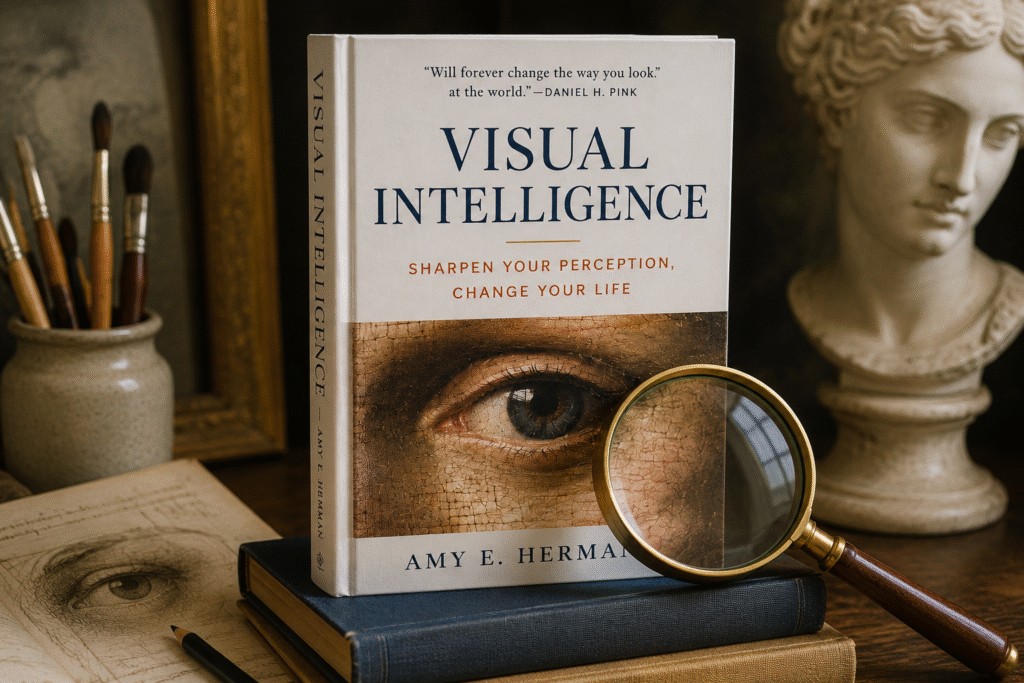
What do Leonardo Da Vinci, Sir Isaac Newton, Velcro inventor George de Mestral and Sir Arthur Conan Doyle have in common? In her book Visual Intelligence, Amy E. Herman provides the answer and makes the case that “the ability to see, to pay attention to what’s in front of us, is not only a means to avert disaster, but also the precursor and prerequisite to great discovery.”
Learning to See
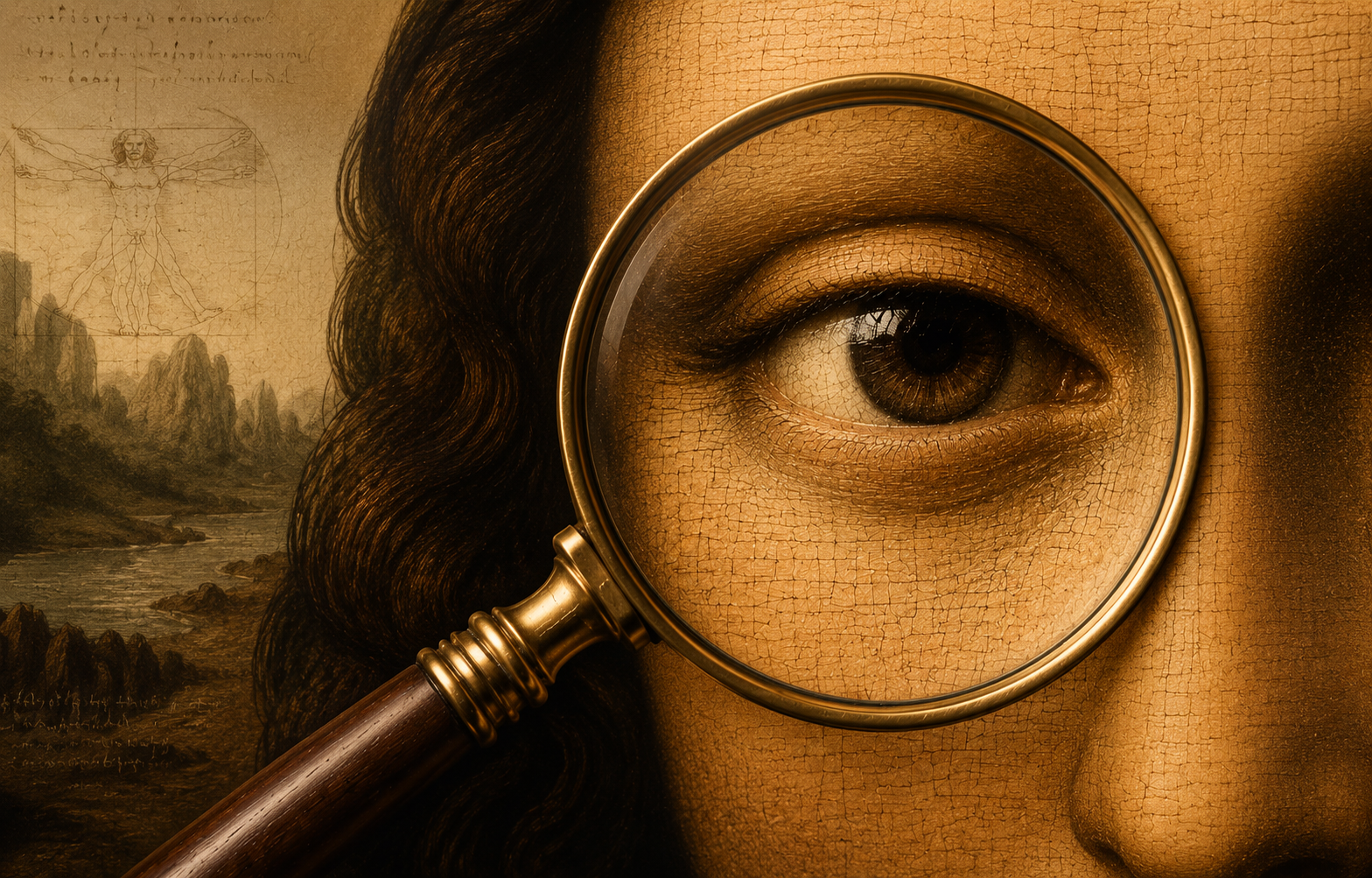
Both Leonardo DaVinci’s own assertion that all of his artistic and scientific accomplishments could be attributed to the concept of “saper vedere” (“knowing how to see”) and Sir Isaac Newton’s declaration, “If I have ever made any valuable discoveries, it has been owing more to patient attention than to any other talent” would tend to agree with Herman’s proposal.
Conan Doyle’s iconic character Sherlock Holmes was inspired by Dr. Joseph Bell (a relative of Alexander Graham Bell), whose real-life demonstrations of the powers of observations during his lectures, along with his constant exhortations to his medical students to “use your eyes, use your eyes” and “most people see, but not observe” were as legendary as the character he inspired became. And as for Swiss inventor George de Mestral, if he had not paid close attention to the burrs clinging to his socks during a hike, he never would have invented Velcro and the world — and even astronauts’ gear — would be poorer for it.
The Art of Perception
As both a lawyer and art historian, Herman is uniquely qualified to combine her two passions into a groundbreaking program. During her legal career, she was haunted by an episode in which she witnessed armed police officers answering a domestic violence call. Thankfully, the incident ended well, but she realized in that moment how much our very lives can hang in the balance based on other people’s observational skills, or lack thereof. As a lawyer, she also experienced firsthand the unreliable nature of eyewitness accounts.
It wasn’t until she returned to her art background as the head of education at the Frick Collection in New York City that everything came together. There, she helped introduce a course created by a Yale dermatology professor who taught medical students to analyze works of art in order to improve their patient diagnostic skills. The results were remarkable; studying art improved the students’ power of observation by 56 percent.
Curious to understand the neuroscience behind those results, her quest began. As she began to share her findings, friends reeling from 9/11 urged her to train first-responders. Thus, her groundbreaking program, The Art of Perception, was born, with an inaugural class of NYPD officers at the Frick.
Almost twenty years later, after teaching thirteen divisions of the NYPD, the FBI, Department of Homeland Security, Scotland Yard, the Secret Service as well as various branches of the military, Fortune 500 companies, librarians, medical students and coutnrless other professionals, Herman’s Art of Perception program has helped thousands of people stop missing critical information. As she puts it, “in reality, all of us – parents, teachers, flight attendants, investment bankers, even doormen – are first responders on some level.”
This book is the product of two decades of wisdom and experience accrued in teaching those people, and, as she promises “unlike other books by psychologists or reporters, this one will not just tell you what your brain can do or how people are using theirs to the limit, it will show you.” And show the reader she does. The book’s various photographs, paintings and sculpture installations help every reader see both the art itself and the information it conveys in novel ways that will carry over into everyday life. The exercises encourage us to slow down, notice more, observe more actively, and interpret visual information more thoughtfully — skills that extend well beyond the museum and into everyday life.
I say that as an artist who is fairly well versed in art history; even though I was already familiar with several of the works featured, the exercises sharpened my perception skills and I found every one of them thought provoking, not only from an artistic standpoint, but also in the broader context of effective communication.
The Science of Observation
One of the book’s greatest strengths is that Herman doesn’t simply argue that observations matter; she explains why it can be taught. Visual Intelligence also explores the fascinating neuroscience behind the process of observation. Dr. Sebastian Seung, a prominent neuroscientist, explains that while we often think of our eyes as being responsible for sight, “ it’s really our brain…Not only does processing what we see engage a full 25 percent of our brain and over 65 percent of our brain pathways – more than any of our other sense – it begins in a part of the eye that is really the brain.” Who knew? The retina is actually part of the brain and not just the eye?!
As Dr. Seung explains, “The retina is such a complicated structure that it’s not even a camera. It’s more like a computer…. Studying the retina is our easiest way into the brain, because it is the brain.” Neuroscience also explains why most of us would benefit from Herman’s teaching. Human beings are continuously bombarded with stimuli, forcing the brain to pick which ones to focus on, which leads to what we think of as “attention.” Our attention is finite and the resulting “inattentional blindness” means that when our attention is absorbed by anything, even a task as banal as counting, we can miss something enormous right in front of us. Sometimes with deadly consequences. That’s the bad news.
The good news is that we can teach our brains to have better attention and observation skills. As American psychologist Samuel Renshaw said, “Proper seeing is a skill which needs to be learned, like playing the piano, speaking French or playing good golf.” In fact, Renshaw’s research regarding vision training was used to help Allied forces recognize enemy warcraft more quickly during World War II.
Technology hasn’t helped, providing not just a constant stream of distractions but also reducing our attention spans. Herman cites studies showing that the average person checks their phone more than 110 times a day, while a 2005 study found that workers suffered a 10-15 IQ point loss when distracted. It can also lead to an over-reliance on technology at the expense of our own powers of observation. In fact, the earliest versions of The Art of Perception were implemented because medical school instructors noticed that new students were relying too much on advanced technological equipment and not enough on their own observational skills.
Why Art?
Understanding how we see naturally leads to another question: if observation can be trained, why has Herman chosen art as her classroom? As she explains, “Art gives us myriad opportunities to analyze complex situations as well as seemingly more straightforward ones.” Works of art “transport us away from our everyday life to rethink how we see and perceive and communicate.” Neuroscience research suggests that “discomfort and uncertainty bring out the best in our brains…” Rather than rushing to conclusions, art invites us to slow down, tolerate ambiguity and consider multiple interpretations. As Herman reminds us “slowing down doesn’t mean being slow, it just means taking a few minutes to absorb what we are seeing.” Neuroscientists believe that practicing new skills rearranges the brain’s internal connectors. So technically, biologically we can wire our brains to see better.
The average museum visitor spends seventeen seconds viewing each work of art. By contrast, Harvard art professor Jennifer Roberts requires three hours for her students. Fortunately, the exercises in Visual Intelligence require nowhere near that level of commitment, yet the results will be tangible and noticeable, nonetheless.
The Four A’s
The book doesn’t stop at explaining why observation matters; it also provides readers with a practical framework for putting these newly acquired skills into practice with a system entitled the Four A’s: Assess, Analyze, Articulate and Adapt.
Whether evaluating a work of art, interviewing a witness, diagnosing a patient, or simply navigating the complexities and ambiguities of everyday life, this framework encourages reader to gather information more carefully, communicate it more accurately, and remain flexible as new evidence emerges. Unfortunately, as Herman writes, “not paying attention can lead to far more than missed opportunities…it can put us in physical danger.”
Observation Can Change Lives
One of the most inspiring examples recounted in the book is that of Derreck Kayongo, a Ugandan immigrant who noticed that every day during his hotel stay, a new bar of soap was placed in his bathroom while the partially used one was discarded. As he recalled, “I quickly realized that if only half of the hotels did this, it was an incredible amount of soap – hundreds of millions of bars just being dumped into landfills”. Kayongo also knew that more than 2 million people, the majority of whom were toddlers, died every year from diarrheal disease, an illness that can easily be prevented by the simple act of hand washing using soap. Most people would have seen waste, but Kayongo saw opportunity. He set about collecting old soap from hotels, found a recycling facility to scrape, nelt ad disinfect the recuperated soap bars, and the Global Soap Project charity was born. He has since recycled over one hundred tons of soap and redistributed them to people in over thirty-two nations across four continents. As Herman concludes, “The ability to see, to pay attention to what is often readily available right in front of us, is not only a means to avert disaster but also the precursor and prerequisite to great discovery.”
Visual Intelligence succeeds because it combines a compelling blend of inspiring stories, with neuroscience and effective practical techniques that readers can begin to apply immediately. It transforms observation from an abstract concept into a learnable skill that demonstrating that seeing more clearly is not a gift possessed by the exceptional few, but an ability that can be developed and strengthened through practice so that we can all unleash our inner Sherlock Holmes.
Observation Can Save Lives
“This book should alter how readers look at the world” is a claim on the cover, and it is one that this book more than lives up to. As does its subtitle: “Sharpen Your Perception, Change Your Life”. But I would go a step further. As recounted in chilling detail in the book, multiple survivors of the Westgate shopping mall terrorist attack in Nairobi made it out alive because of their own powers of observation, having to distinguish between the terrorist and the undercover police and having to find hiding places. One man survived because he noticed that the man who approached was wearing standard-issue police boots, something the terrorist were unlikely to have been wearing. Another group survived because they noticed the mall’s decorative pillars were hollow and thus used them as a hiding spot. Sharpening your perception will not only change your life– it may actually save it.
https://geni.us/M1s04i Please consider using the ColourAddict Amazon affiliates link if you decide to purchase this book. It doesn’t cost you more, and it helps support the Book of the Month.